Last Updated: November 2026
Not always. A heat pump needs its own 240-volt circuit and a disconnect at the outdoor unit, and electric backup heat needs a larger circuit of its own. Whether your panel can carry them depends on its rating, what is already on it and a load calculation under the electrical code. Many houses replacing a central AC already have most of what they need.
Every Sundog estimate visit includes a panel check, so any electrical work and its permit are on the written estimate before you decide, never added halfway through the job. Aurora reviews new electrical permits under the 2026 National Electrical Code from August 1, 2026.
What a heat pump adds to the panel
The numbers below are the physics of each load. The nameplate on your specific equipment sets the actual wire and breaker sizes.
| Part of the system | What it needs | Note |
|---|---|---|
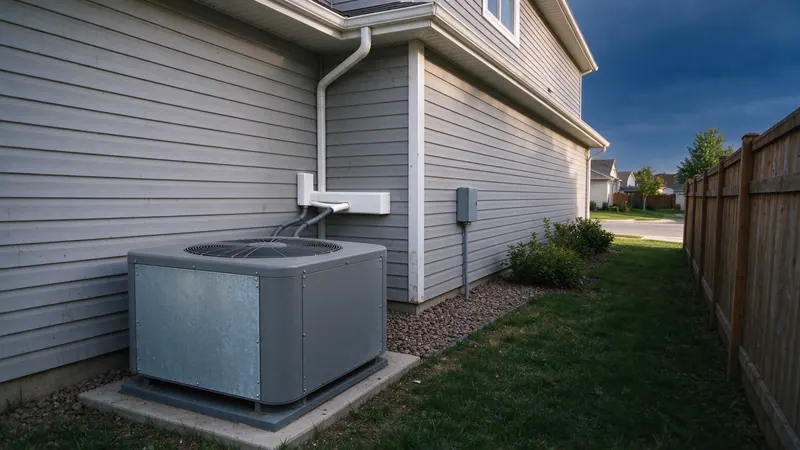
| Outdoor unit | A dedicated 240-volt circuit sized from its nameplate | Often replaces the old AC's circuit, if that circuit matches |
| Disconnect | A switch within sight of the outdoor unit | Lets the unit be shut off safely for service |
| Air handler blower | A circuit, often shared with the strip heater in one cabinet | Variable-speed blowers draw little |
| 5 kW electric strip | About 21 amps at 240 volts | Delivers about 17,000 BTU per hour |
| 10 kW electric strip | About 42 amps at 240 volts | Delivers about 34,000 BTU per hour |
| Thermostat and controls | Low-voltage wiring only | No panel space needed |
Reading the nameplate
Every outdoor unit and air handler carries a label with two numbers that matter most for the panel.
Minimum circuit ampacity (MCA)
The smallest wire the circuit can use. It already includes the code's allowance for the compressor or heater running for long periods.
Maximum overcurrent protection (MOP)
The largest breaker allowed. A variable-speed outdoor unit often has a lower MCA than the old single-stage AC of the same size, which is one reason a swap may need no new circuit at all. A cold-climate model can draw more at full speed in the cold, so we read its nameplate, not the old one.
How we check your panel
The panel check on the visit looks at capacity and condition, then at what the new system adds against what it removes.
- The service rating on the main breaker: 100, 125, 150 or 200 amps
- Free breaker spaces, or whether tandem breakers are allowed in that panel
- Large loads already on it: range, dryer, water heater, hot tub, EV charger
- What leaves with the job: an old AC circuit, a furnace that goes, or one that stays
- The panel's age and condition, including any make the electrical trade treats with caution
- A load calculation for an existing dwelling, which the code allows to use a year of actual demand data where it is available
Want your own number? We start from your house and your bills.
Get an EstimateWays to avoid a service upgrade
A panel that looks full is not always a panel that is out of capacity. These choices change what the system asks of it.
Smaller, staged backup
A strip sized to the real gap at design instead of the whole house can drop a 15 kW circuit to 5 kW.
Dual fuel
Keeping a gas furnace as backup removes the strip heater altogether. See dual-fuel heat pumps.
Reuse the AC circuit
When the new outdoor unit's nameplate fits the existing wire and breaker, the circuit stays as it is.
Energy management device
Where the code and the utility allow it, a device that keeps two large loads from running at once, such as the strip and an EV charger.
When an upgrade is the honest answer
Some houses do need more capacity, usually older 100-amp services planning all-electric heat with a large strip, or homes adding an EV charger at the same time.
Panel replacement
A new panel on the same service adds spaces and replaces a worn or problem panel. It needs its own electrical permit.
Service upgrade
Raising the service size also involves Xcel Energy for the meter and service connection, which adds scheduling time. We plan it into the job from the start.
How the electrical work fits the install
The electrical side runs alongside the mechanical work, with its own permit and its own inspection. Planning it from the visit is what keeps it from holding up the job.
At the visit
We read the panel, the old nameplates and the path from the panel to the outdoor spot, since a long or difficult wire run changes the price as much as the breaker does.
On the estimate
Each circuit, the disconnect and any panel or service work appear as separate lines, along with the electrical permit.
On install day
Circuits are run and landed before start-up, so the system is tested on its permanent power, not a temporary feed.
At inspection
The city inspects the electrical permit separately from the mechanical one. For a heat pump replacement that reuses the AC circuit, the electrical scope can be very small.
Find out before you choose equipment
Send a photo of your panel and the old outdoor unit's nameplate when you request an estimate, or call Sundog at (719) 417-2475. On the Hoffman Heights dual-fuel job on our homepage, one new 40-amp circuit covered it. For sizing, read heat pump sizing, and for the order of the work, the installation process guide. The planning guide puts it all together, and the cost page shows how electrical work moves the price.
Get an EstimateQuestions people ask
Can a heat pump use my old AC circuit?
Often, if the new outdoor unit's minimum circuit ampacity and maximum breaker fit the existing wire and breaker. We check the nameplate against what is in the panel.
Will a 100-amp panel work with a heat pump?
Sometimes. A heat pump with gas backup or a small strip may fit; all-electric heat with a large strip often does not. The load calculation decides.
Is the electrical permit part of the job?
Yes. Circuit and panel work are permitted with the job in Aurora, and the electrical work and permit appear on the written estimate as their own lines.