Last Updated: November 2026
Plan a heat pump from the house outward. Measure the heat loss room by room, choose a model by its output at 5°F, check that the ducts carry its airflow and the panel carries its circuits, then decide what covers the coldest hours: your gas furnace, electric backup or very little. Cost, rebates and running cost follow from those choices.
This guide walks each step in that order, with links to a deeper guide for each one. Sundog installs ducted heat pumps, dual-fuel systems and ductless mini-splits across Aurora and the towns around it, and every estimate visit starts with the same measurements this guide describes.
The short version
- Most Aurora houses with a furnace and ducts can use a ducted heat pump; whether the ducts carry its airflow is the first thing to measure.
- Size comes from a room-by-room load calculation, not the old system's tonnage.
- Choose equipment by its published output at 5°F; the cold-climate label sets tested minimums.
- Almost every house keeps some backup heat for the coldest hours and defrost: a gas furnace, electric strips, or a small strip.
- The panel needs room for the outdoor unit's circuit and any electric backup; a full upgrade is not automatic.
- Sundog's typical range for a cold-climate ducted heat pump with suitable existing ducts is $13,000 to $25,000, set at the site visit and written estimate.
- Xcel Energy runs a residential heat-pump rebate that depends on your address, the equipment and the installation path; the federal 25C credit ended for systems installed after 2025.
- Running cost depends on your own gas and electric rates and where the backup takes over; nobody can honestly promise a savings percentage.
How a ducted air-source heat pump moves heat
- Outdoor coil: colder than the outdoor air, so it absorbs heat
- Reversing valve: flips the direction for summer cooling
- Compressor: squeezes the refrigerant to a higher temperature
- Line set through the wall
- Indoor coil at the air handler or furnace: releases the heat
- Supply duct: the warmed air goes to the rooms
A heat pump does not make heat by burning anything. It moves heat that is already in the outdoor air into the house, using the same refrigerant loop as a central air conditioner, run in reverse.
In winter
Refrigerant in the outdoor coil is colder than the outdoor air, even on a freezing night, so it absorbs heat. The compressor squeezes that refrigerant to a higher temperature, and the indoor coil at your air handler or furnace releases the heat into the air your ducts carry.
In summer
A reversing valve flips the direction. The indoor coil absorbs heat from the house and the outdoor unit rejects it, exactly like the AC it replaces.
Why it is efficient
Because it moves heat rather than making it, a heat pump delivers more heat than the electricity it uses. That ratio is the coefficient of performance, or COP. A COP of 3 means three units of heat for one unit of electricity; an electric strip heater is always 1.
Single-stage, two-stage or variable speed
Heat pumps differ most in how their compressor runs. In Aurora's long heating season, that difference shows up in comfort, cold-weather output and how much the backup runs.
| Single-stage | Two-stage | Variable speed (inverter) | |
|---|---|---|---|
| How it runs | On or off at full output | A low and a high setting | Ramps smoothly from low to above its nominal rating |
| Mild days | Short on-off cycles | Long runs on low | Long, quiet runs at low speed |
| Cold nights | Output falls with no reserve | Some reserve on high | Speeds up to hold more output; most cold-climate models are built this way |
| Fits | Cooling-led replacements, tight budgets | A step up in comfort | Most Aurora houses that want the heat pump to carry the winter |
What changes in summer
In cooling mode a heat pump does exactly what your central AC did, so summer is rarely the deciding season in Aurora. Two details are still worth getting right.
Humidity
A correctly sized, variable-speed unit runs long, slow cycles that pull moisture out of the air. An oversized one cools the house quickly and shuts off before it dries it, which leaves rooms cool but clammy on the occasional humid day.
Upstairs rooms
Bedrooms over a garage or under a low attic gain the most heat. That is a duct and return question as much as an equipment one, and the visit checks both.
Is a heat pump right for your house?
The house usually answers this before the brochure does. These are the situations we hear most often and where each one points. Our fit assessment asks the same questions in a couple of minutes.
The AC failed and the furnace still runs
A heat pump can take the AC's place and share heating with the furnace you keep. That is dual fuel, often the easiest change.
Both are old
Replace both together: either a new furnace with a heat pump, or an all-electric system with a cold-climate heat pump and electric backup.
No ducts, or one room the ducts never reach
A ductless mini-split puts a head in the room. The ducted vs ductless guide and zone planning guide go further.
An existing heat pump is failing
Weigh repair against replacement: age, refrigerant type and how well it ever heated the house all count.
What a heat pump does in an Aurora winter
Every heat pump puts out less heat as the outdoor air gets colder, at the same time the house needs more. The question is how much it keeps. ENERGY STAR's cold-climate label requires a unit to hold at least 70% of its rated capacity at 5°F, with a COP of at least 1.75 there. The cold-weather performance guide covers defrost, the balance point and snow.
Standard heat pump
Built mainly around its cooling rating. Output drops steeply in the cold, so the backup carries a large share of a cold night. A reasonable fit for dual fuel, where the furnace takes over early.
Cold-climate heat pump
Tested and published at 5°F, usually with a variable-speed compressor. It carries far more of the winter on its own, which is what makes all-electric heat practical in many Aurora houses. Check the model on NEEP's cold-climate list.
Sizing: start from the house, not the old label
A Manual J load calculation adds up heat lost through walls, windows, ceilings, air leaks and ducts at local design conditions, and the heat gained on a summer afternoon. In Aurora the heating side usually decides the size.
Why not match the old tons
The old system was sized before windows, insulation or a finished basement changed the house, and often generously to begin with. An oversized heat pump short-cycles in spring and leaves summer air damp; an undersized one leans on backup.
How the size is chosen
Compare the heating load at design with the equipment's output at 5°F; the difference is what the backup covers. The sizing guide runs those numbers in full, including how a 9,000 BTU gap becomes a 5 kW strip.
Insulate or air-seal first?
If attic insulation or air sealing is already on your list, settle it before the system is sized. The load calculation describes the house as it will be.
Envelope work first
Lowers the heating load, sometimes enough to drop a size or shrink the backup strip, and the savings carry on for the life of the house.
Heat pump first
Fine when no envelope work is planned soon. Insulation added later still cuts runtime; the system simply has a little extra headroom.
Keep the furnace, replace it, or go all-electric
This is the decision most Aurora owners spend the longest on. There is no single right answer: the furnace's age, the panel, your rates and how much gas you want to keep all count. The backup heat guide and heat pump vs gas furnace guide go deeper, and furnace-to-heat-pump conversion covers the all-electric switch.
| Keep the furnace (dual fuel) | Replace both (new furnace + heat pump) | All-electric | |
|---|---|---|---|
| Backup heat | Your existing furnace below a set temperature | The new furnace | Electric strips in the air handler |
| Needs | A furnace in good shape whose blower and coil match | Room for both; a matched coil and blower | Panel room for the strips; a cold-climate model |
| Gas use | Only on the coldest hours | Only on the coldest hours | None for heating |
| Watch for | An old furnace failing a year later | Higher cost now | Strip size against panel capacity |
| Sundog's typical range | Set at the visit; heat pump and coil only | $19,000 to $28,000 | $13,000 to $25,000 with suitable ducts |
Can your ducts carry the airflow?
A heat pump delivers air that is warm rather than hot, so it needs its full airflow, roughly 350 to 450 cubic feet per minute per ton. A gas furnace hid weak ducts for years; a heat pump shows them in the far bedrooms. The ductwork guide explains the readings. On the visit we check:
- Total external static pressure at the blower, against the blower's rating, often 0.5 inches of water column
- Return size and count, the most common restriction in older Aurora ranches
- Crushed, kinked or sagging flex runs and leaky trunk joints
- Ducts in crawlspaces, attics and garages, where leaks cost the most
- The filter rack, and whether air slips around the filter
Does your panel have room?
A heat pump needs a dedicated 240-volt circuit and a disconnect at the outdoor unit. Electric backup needs its own larger circuit: a 10 kW strip draws about 42 amps. Aurora reviews new electrical permits under the 2026 National Electrical Code from August 1, 2026. The electrical panel guide covers it in detail.
Often no upgrade
Replacing a central AC frees its circuit, and a variable-speed outdoor unit often draws less than the old AC. Dual fuel needs no strip circuit at all.
Sometimes an upgrade
An older 100-amp service planning all-electric heat with a large strip, or one adding an EV charger at the same time. A load calculation decides, and we check the panel before the estimate is final.
Want your own number? We start from your house and your bills.
Get an EstimateWhere the outdoor unit goes
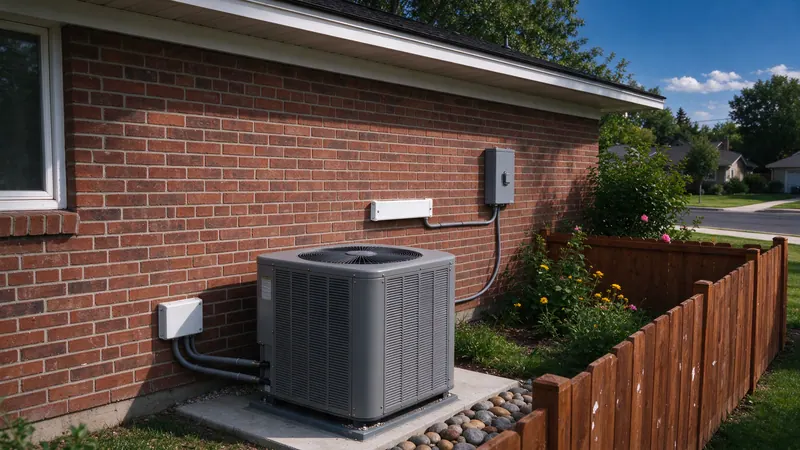
- Stand or bracket lifts the coil above drifts
- Snow line
- Roof drip line: ice stays off the fan
- A path for defrost water to drain away
- Short, clean line-set route to the indoor unit
- Space around the unit so it breathes
Placement decides whether the unit breathes, drains and stays quiet through the winter. NOAA's 1991 to 2020 normals put annual snowfall near 49 inches at the old Stapleton station, about 9 miles from central Aurora, so height and drainage matter.
Above the snow, out of the drip line
A stand or bracket lifts the coil above drifts, and the unit sits clear of the roof edge so icicles and sheet ice don't land on the fan.
A path for defrost water
Defrost sends melt water out of the coil several times on a damp cold day. It needs to drain away rather than refreeze under the unit. Our blog post on outdoor unit placement and frost and defrost post cover both.
Line set and neighbors
A short, clean line-set route to the indoor unit, a path to the panel, and distance from bedroom windows on both sides of the fence.
Thermostat and controls
Controls decide when the heat pump runs, when the backup joins in and how the house recovers after a setback. They are set at start-up, not left on factory defaults.
An outdoor sensor
Lets the system switch to the furnace or lock out the strips at a set outdoor temperature.
Staged backup
Strips come on one stage at a time, and only when the heat pump cannot keep up.
A heat-pump-aware thermostat
It needs to know it is running a heat pump, how many stages it has and how to recover gently after a setback.
The changeover point
In a dual-fuel house it is set from your Xcel gas and electric rates and the heat pump's output, not habit.
How the installation runs
Most single-system installs take one to four days on site, longer with duct work or a panel upgrade. The installation process guide covers each step, and our preparing for install day post covers what to clear.
Visit
Load calculation, ducts and airflow, panel and the outdoor spot.
Written estimate
Model numbers and low-temperature capacity, duct and electrical work, permit, removal, pad or stand and start-up checks, each on its own line.
Permits
A mechanical permit under the 2021 International Mechanical Code Aurora has adopted, and an electrical permit for circuits or panel work.
Install
Old equipment out and refrigerant recovered; lines run, pressure-tested and evacuated; wiring, charge and controls.
Start-up and inspection
Airflow, charge and control readings recorded and left with you with the model numbers and rebate paperwork; then the city's inspection.
Refrigerant and the line set
Under EPA's Technology Transitions rule, new residential split systems have moved from R-410A to lower-impact refrigerants, mainly R-454B and R-32. That affects two things on your estimate.
The equipment
These A2L refrigerants are mildly flammable and come with their own installation rules and leak sensors, which the install follows to the manufacturer's instructions. An old R-410A outdoor unit cannot simply be matched to a new indoor coil.
The line set
Existing copper lines can sometimes stay, depending on their size, condition, route and what the new manufacturer allows. When they stay they are flushed and tested; when they don't, new lines are a separate item on the estimate.
What a heat pump costs with Sundog
Sundog's typical range for a cold-climate ducted heat pump with suitable existing ducts is $13,000 to $25,000. Your own price comes from the site visit and the written estimate, where every item is listed separately so two quotes can be compared line by line. The installation cost page breaks the price down, and the cost estimator shows where your house is likely to land.
| System | Sundog's typical range |
|---|---|
| Cold-climate ducted heat pump, suitable existing ducts | $13,000 to $25,000 |
| Dual fuel with a new gas furnace and cold-climate heat pump | $19,000 to $28,000 |
| Ductless, one zone | $4,500 to $9,500 |
| Ductless, two to four heads | $9,000 to $18,000 |
What moves a job within its range: capacity and cold-weather rating, duct corrections, a new circuit or panel work, line-set length, the pad or stand, and how hard the furnace is to reach.
When you compare quotes, compare them before rebates and item by item. A rebate depends on the address and the equipment, so a quote that leads with an after-rebate number is only as good as the eligibility check behind it.
Rebates and incentives in Aurora
Incentives change more often than equipment, so treat any figure you read as something to check. Xcel Energy supplies electric and gas to most Aurora homes, checked by address. The Aurora rebates guide and incentive checklist cover the details.
What applies
Xcel runs a residential heat-pump rebate whose eligibility depends on your address, the equipment and the installer path. Its current page sets installation by December 31, 2026 and applications through September 30, 2027, so check the current program dates. Aurora's F-3 program covers a mapped area with active Xcel gas service. The federal 25C tax credit ended for systems installed after 2025.
What we do
We check what applies to your address before the estimate is final and list what the program needs, typically AHRI-matched model numbers, the invoice and an installer in the program's network. The rebate paperwork is left with you at start-up.
What it costs to run
Running cost depends on three things: your gas and electric rates, how efficiently the heat pump runs through your winter, and where the backup takes over. That is why we work from your own Xcel bills, and why no one can honestly promise a savings percentage.
The comparison that matters
For 100,000 BTU of delivered heat, gas costs one therm divided by the furnace's efficiency. A heat pump uses 29.3 kWh divided by its COP at that temperature, times your electric rate. Run both at a few outdoor temperatures and you see where each is cheaper for your house.
What pushes bills up
Strips running when they don't need to, deep setbacks that trigger backup in the morning, and an undersized unit. The operating cost guide works through Colorado rates in detail.
Living with it: maintenance and repairs
A heat pump runs in both seasons, so it sees more hours than a furnace or AC alone. Simple care keeps it near its start-up readings. Sundog's typical range for a heat pump maintenance visit is $100 to $200; the maintenance checklist lists what to do yourself.
- Check the filter monthly in heating and cooling season, and change it when it looks gray
- Keep snow, leaves and drifts clear of the outdoor unit and its base
- Watch for ice that thickens and never clears; normal defrost clears on its own
- A yearly visit: coil cleaning, drain and electrical checks, charge and airflow readings compared with start-up
- Cold air in heat mode, short cycling or a tripping breaker calls for a repair visit
Heat pump compared with other systems
Heat pumps get compared with almost everything else that heats or cools a house. Here is how they line up.
| Compared with | The difference |
|---|---|
| Central air conditioner | Same refrigerant loop; a heat pump also runs it in reverse to heat. Cooling is the same. |
| Gas furnace | A furnace burns gas for heat; a heat pump moves outdoor heat inside and also cools. Many Aurora houses use both. |
| Ductless mini-split | Also a heat pump, with heads in each room and no ducts. Suits additions, basements and homes without ducts. |
| Electric baseboard or strips | Resistance heat delivers one unit of heat per unit of electricity; a heat pump delivers more in most conditions. |
| Ground-source (geothermal) | Draws heat from buried loops rather than outdoor air. A different trade with excavation, and outside the work we do. |
Questions to ask any installer
Whoever you hire, these questions separate a quote sized to your house from one copied off the old nameplate. ENERGY STAR's hiring tips cover the same ground.
- Was a room-by-room load calculation done, and can I see the totals?
- What is the matched system's output at 5°F, and is the pair listed in the AHRI directory?
- What did the static-pressure reading show, and what duct work does that call for?
- How big is the backup, why, and at what outdoor temperature does it lock out or change over?
- What electrical work and permits are included?
- What start-up readings will I get, and which rebates apply to my address?
Where to go next
Each part of this guide has a deeper page. Start with whichever question is holding you up.
Choosing a system
Heat pump vs gas furnace, ducted vs ductless and mini-split zone planning.
Getting the design right
Sizing, cold-weather performance, backup heat, ductwork and the electrical panel.
Money
Aurora rebates, the incentive checklist and operating cost in Colorado.
After install
The installation process, the maintenance checklist and repair or replacement.
Start with your house
The fastest way through all of this is a visit that measures the house, the ducts and the panel, then puts the options side by side in writing. Call Sundog at (719) 417-2475 or book an estimate visit. If you are replacing an existing system, see heat pump replacement; for a printable list of what to ask any installer, see our resources.
Get an EstimateQuestions people ask
Will a heat pump keep my Aurora house warm in January?
A cold-climate model sized to your house carries most of the winter. For the coldest hours and defrost you keep a backup, your furnace or electric heat, unless the numbers show the house does not need one.
Do I have to remove my gas furnace?
No. In a dual-fuel system it stays as the backup, provided it is in good condition and its blower and coil can work with the heat pump.
What should a heat pump estimate include?
Model numbers and capacity at low temperatures, duct and electrical work, the permit, removal, the pad or stand and the start-up checks, each on its own line, with the load calculation behind the size.