Last Updated: November 2026
A heat pump install is not one event. It is a short chain of stages: the visit, the written estimate, the permit, the work itself, then start-up and inspection. Each stage needs something small from you, usually access, a decision or a piece of paperwork.
This walkthrough follows a typical ducted heat pump installation in an Aurora house with a basement furnace and ducts to every room, the setup most Aurora houses already have. The stages are the same for a ductless system, with attics and closets in place of the basement. At the end there is a checklist you can work through the week before.
The stages of a typical job
1. The estimate visit
We measure the house room by room for the load calculation, check the ducts and airflow, read the electrical panel and walk the outdoor spot. You show us the rooms that bother you and where the snow piles up.
2. The written estimate
Model numbers and low-temperature capacity, duct and electrical work, the permit, removal, the pad or stand and start-up checks, each on its own line. We check rebate eligibility for your address before it is final.
3. Permits and equipment
Once you accept, the mechanical and electrical permits are pulled and the equipment is ordered to match the estimate.
4. The install
Old equipment out, new equipment in, lines run and tested, circuits wired. The heating and cooling are off while the swap happens.
5. Start-up and inspection
Airflow, charge and controls are checked and recorded, then the city inspects the permitted work.
What happens inside and outside on install day
Most of the work happens in two places at once, and both need a clear way in.
In the basement or utility room
The old furnace or air handler and coil come out, with the refrigerant recovered from the old system. The new indoor equipment is set and connected to the supply and return. Any duct work on the estimate, such as a larger return or a repaired run, is done now. The condensate drain is run to the floor drain or a pump, and a condensing furnace in a dual-fuel job gets its venting. The thermostat is wired for the backup heat you chose.
Outside
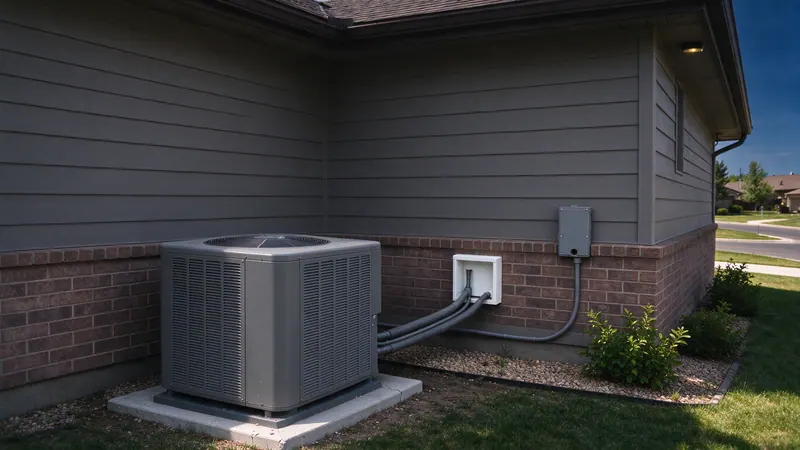
The old condenser is removed and the pad or stand set in the spot we agreed. The line set is run through the wall, pressure-tested with nitrogen and pulled into a deep vacuum, checked on a micron gauge, before refrigerant is released. The outdoor circuit and disconnect, and any circuit for electric backup heat, are run from the panel.
Start-up is where the job gets proved
A system that turns on is not the same as a system that is set up right. At start-up we measure airflow and static pressure, confirm the refrigerant charge, check the defrost and backup heat operation and set the controls, including the changeover point on a dual-fuel system. Those readings, the model numbers and the rebate paperwork are left with you.
Then the city inspects. Aurora reviews mechanical work under the 2021 International Mechanical Code, and new electrical permits are reviewed under the 2026 National Electrical Code from August 1, 2026. The inspector needs access to the indoor equipment, the outdoor unit and the panel. Our guide to the heat pump installation process goes deeper on each test.
Want your own number? We start from your house and your bills.
Get an EstimateYour checklist for the week before
None of this is required to start, but each item removes a common reason for a pause on the day.
- Clear a path from the outside door to the furnace or air handler, and the floor space around it; move storage boxes, bikes and laundry
- Clear the outdoor spot: planters, firewood, hoses and any snow or ice along the route to it
- Leave room in the driveway or at the curb for a work vehicle and a trailer for the old equipment
- Tell us about pets, alarm systems, gate codes and any doors that stick or lock
- For a ductless job, clear the closets and attic hatches the line sets run through
- Get any HOA approval you need for the outdoor unit's location in writing
- Find your most recent Xcel Energy bill; rebate applications ask for account details
- Plan for the house to be without heating or cooling during the swap; on a cold day, decide which room you will use and keep a space heater on its own outlet
- Make sure someone over 18 can be home or reachable during the work and for the city inspection
Decisions to make before the install, not during it
These choices are easier with the estimate in front of you than with the old furnace already on the driveway.
| Decision | Why it matters on the day | Where to read more |
|---|---|---|
| Backup heat: furnace, electric strip or none | Sets the thermostat wiring, the circuits and the panel work | Backup heat guide |
| Panel upgrade or load management | Has to be permitted and scheduled with the utility if service changes | Electrical panel guide |
| Rebate path | Some programs need specific equipment and installer status before the work starts | Aurora rebate guide |
| Thermostat location and type | Needs to match the backup and staging you chose | Discussed at the estimate visit |
Keeping the rebate paperwork straight
Xcel Energy runs a residential heat-pump rebate whose eligibility depends on your address, the equipment and the installer path, and it has its own installation and application deadlines; check the current program dates before you plan around them. We confirm what applies before the estimate is final. After the install, keep the invoice, the AHRI-matched model numbers and the start-up sheet together in one folder. The federal 25C credit ended for systems installed after 2025, so it is no longer part of the plan. Our incentive checklist lists what each program asks for.
Start with the visit
Everything above follows from a good estimate visit. If you are early in the decision, the Aurora heat pump planning guide walks through it in order. When you are ready, contact us or call (719) 417-2475 to book the visit.
Get an EstimateQuestions people ask
Do I need to be home for the whole install?
Someone needs to let the work in, answer questions about access and be reachable through the day. You also need someone at home, or a way in, for the city inspection.
Will the house be without heat during the install?
Yes, while the old system is disconnected and the new one is set and tested. On a cold day it helps to pick one room to keep warm with a space heater and close it off.
What do I get at the end?
The start-up readings, the model numbers and the rebate paperwork, along with the permit records once the city has inspected.