Last Updated: November 2026
A heat pump that blows cool air on a January morning might be in a normal defrost cycle, low on refrigerant, stuck in cooling or running on a failed part outside. From the living room they feel alike. Sundog repairs ducted heat pumps and ductless mini-splits across Aurora, and every repair starts with a diagnosis that tells those causes apart.
What you tell us when you call shortens that work: what the system is doing, when it started, what the thermostat shows, and whether the outdoor unit is running, iced or silent. Sundog's typical range for a routine heat pump repair is $150 to $1,200, and for major components such as a compressor or reversing valve $1,500 to $3,500, confirmed in writing once we know the cause.
Proving a reversing valve before replacing it
- Project price
- $2,650
- On site
- 6 hours
- Where
- Welby
- The house
- Mid-1970s ranch with basement
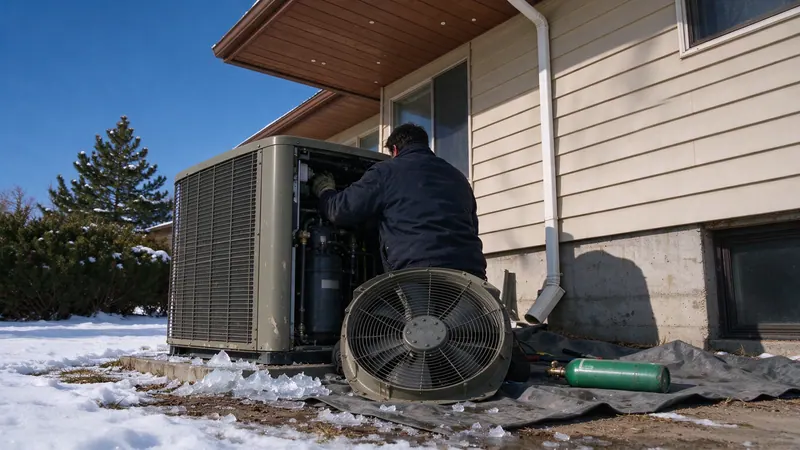
Cool air from a heat pump in January has several possible causes, and the cheapest fix is not always the right one. In this mid-1970s Welby ranch, the nine-year-old heat pump did not shift into heat, so the basement air handler's 10 kW strip was doing all the heating.
We tested in order. The reversing valve's solenoid coil received 24 volts and pulled in on a heating call, so the coil was fine. Line temperatures around the valve showed it was not shifting, and the compressor and charge read healthy. That pointed to the valve itself. On a system this age, replacing one major component makes more sense than replacing the whole system.
The repair was careful bench work done in the field. With the refrigerant recovered and the top and fan removed to reach the valve beside the compressor, we brazed in the new valve under flowing nitrogen with a wet rag on the body, because overheating warps the slide inside. A new filter-drier went in, then a nitrogen pressure test and a vacuum held below 500 microns, held longer because of the cold. The charge went back in by weight.
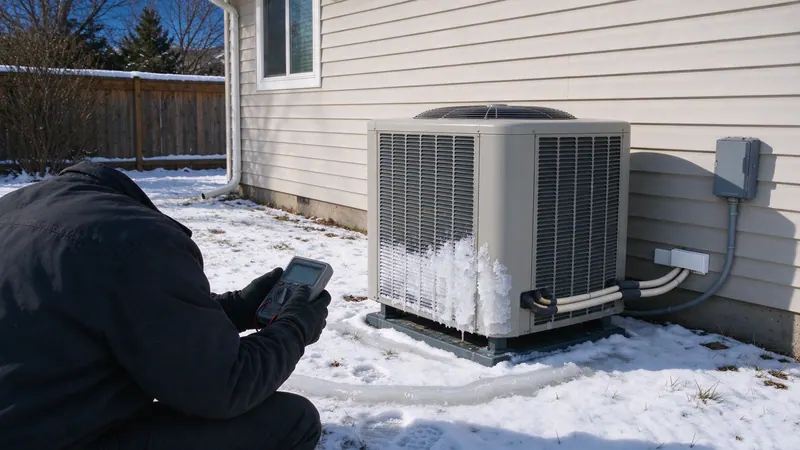
The unit also sat under an eave with no gutter, and meltwater had built an ice ridge around its base. We cleared the ice and the base-pan drain, forced a defrost cycle to prove the repair, and recommended a diverter over the unit.
What happens on the first visit
We test in order, from the cheapest explanation to the most expensive, and we stop guessing as soon as a reading proves the cause.
Thermostat and controls
We confirm the thermostat is calling for the right mode, then check the signal at the air handler and outdoor unit. A wrong setting, a failed wire or a backup-heat lockout set in the wrong place is the cheapest fix there is.
Electrical parts
We test the capacitor, contactor, fuses and connections, and measure voltage and amp draw on the compressor and fan motor. Weak capacitors are among the most common failures.
Refrigerant circuit
We read pressures and line temperatures to see whether the charge is right and whether the reversing valve and metering device are doing their jobs. Low charge means a leak, and we look for it before adding refrigerant.
Airflow, drains and defrost
We check the filter, blower and indoor coil, test the condensate drain, and force a defrost cycle to see whether the outdoor coil clears the way it should.
What you can safely check first
A few checks are safe for anyone and sometimes solve the problem. Anything past these belongs to a technician: the outdoor unit carries high voltage and a pressurized refrigerant circuit.
- The thermostat is set to heat or cool, the setpoint is where you expect, and its batteries are good
- The filter is not clogged; a blocked filter alone can freeze a coil in summer or trip a limit in winter
- A tripped breaker can be reset once; if it trips again, leave it off and call
- Snow, ice or leaves are not packed around or on top of the outdoor unit
- Steam from the outdoor unit with the fan stopped for a few minutes is usually a normal defrost cycle
- Never chip ice off the coil with a tool, or remove panels to look inside
- Note any blinking light or error code on the thermostat, the outdoor board or a ductless head; it often points straight at the fault
Normal behavior or a fault?
Heat pumps do a few things a furnace never did, and some of them look like failures. This is how we separate the two. Our note on frost and defrost goes further.
| What you notice | Often normal when | Points to a fault when | What we test |
|---|---|---|---|
| Frost or steam outside | It clears within a defrost cycle | Ice keeps building into a solid block | Defrost control, sensor, airflow, charge |
| Air feels cool at the vents | It is mild and the system runs long and slow | The house loses ground and the backup carries it | Reversing valve, charge, outdoor fan |
| Aux heat light on | It is very cold, or the system is in defrost | It stays on in mild weather | Thermostat staging, lockout setting, capacity |
| Breaker trips | Never normal | Any time | Capacitor, compressor, wiring, circuit size |
| Water at the indoor unit or a ductless head | Never normal | Any time | Drain line, pump, pan, coil icing |
Repair or replace: how we weigh it
Most repairs are worth doing. The question comes up when a major part fails on an older system, and then four things decide it. When the answer is close, we price both options in writing. Our repair or replace guide walks through it.
The rest of the system
A failed reversing valve on a nine-year-old unit with a healthy compressor is a repair. The same valve on a system with a weak compressor, a corroded coil and a leak history is money spent on a short future.
The part and the refrigerant
A capacitor or contactor is a small repair at any age. A compressor is not. Older systems on R-22 face refrigerant that is no longer produced, which moves a refrigerant repair toward replacement.
How well it ever heated
If the house was never comfortable, the cause may be sizing or ducts, and a repair will not change that. Then we look at the load, the ductwork and whether a cold-climate system belongs in the plan.
Rebates for a new system
If replacement wins, Xcel's residential heat-pump rebate depends on your address, the equipment and how it is installed. We check what applies before the estimate is final; check the current program dates with us.
What a repair costs
Sundog's typical range for a routine heat pump repair is $150 to $1,200. Major components such as a compressor, reversing valve or outdoor coil fall in our typical range of $1,500 to $3,500. For a ductless mini-split, our typical repair range is $150 to $1,500.
Diagnosis is its own line
These ranges cover the repair itself. The diagnostic visit is priced separately, so you know what finding the cause costs before any repair is agreed.
What moves the price
The part, whether a leak has to be found and fixed before recharging, the refrigerant type and amount, and access: a valve buried beside the compressor or a ductless head over a stairwell takes longer than a capacitor at the front of the panel.
When a ductless head acts up
Mini-splits fail in their own ways, and most ductless calls come down to water, dirt or a connection. Each head has its own board, sensors and drain, so we test the head that misbehaves and the outdoor unit that feeds it.
Water and smell
A head that drips at its front edge usually has a slow or blocked drain, a failed condensate pump or a coil so dusty it ices up. A musty smell at start-up points to a dirty coil and blower wheel, the kind of buildup a maintenance visit removes. We clear the cause and run water through the drain to prove it flows.
Blinking lights and leaks
Error codes on the head often name a sensor, a fan motor or a communication fault between head and outdoor unit. Slowly falling output across a season points to a leak, most often at a flare connection, which we find and repair before any refrigerant goes back in.
What is included in a repair
- A diagnosis that tests controls, electrical parts, refrigerant and airflow in order
- The readings and the cause explained, with the repair priced before work starts
- Parts matched to your equipment and its refrigerant
- Refrigerant recovered before the circuit is opened, and a leak found before the system is recharged
- Brazed repairs made under flowing nitrogen, then pressure-tested and evacuated
- The system run in heating, cooling where the weather allows, and defrost before we leave
- Notes on anything else we saw, such as roof drip over the outdoor unit or a filter rack that leaks air
Repair now or replace now
| Repair | Replace | |
|---|---|---|
| Usually fits | A failed part on a system that otherwise reads healthy | A major failure on an older system, or a house that never heated well |
| Main checks | Cause proved by readings, condition of the rest | Load, ducts, panel, refrigerant, rebate eligibility |
| What it leaves you | The same system, back to working order | New equipment sized to the house, with start-up readings |
| Our typical range | $150 to $1,200 routine; $1,500 to $3,500 major components | $13,000 to $25,000 for a cold-climate ducted system |
How a repair runs
- Callwhat the system is doing
- Diagnosistested in order
- Pricethe repair in writing
- Repairparts, brazing, recharge
- Retestheating, cooling, defrost
Fewer repairs next winter
Many repair calls trace back to something a maintenance visit catches early: a capacitor drifting out of spec, a slow condensate drain, a coil packed with cottonwood. If the backup heat runs more than it used to, our guide to backup heat explains what normal looks like, and the maintenance checklist lists what you can watch between visits.
Tell us what the system is doing and when it started. Call (719) 417-2475 or book a repair visit.
Get an EstimateHeat pump repair in Aurora
The cause found first, the repair priced against what is left of the system.
Get an EstimateQuestions about heat pump repair
Why is my heat pump blowing cool air in heat mode?
It may be a normal defrost cycle, which ends in a few minutes. If it lasts, the cause can be low refrigerant, a reversing valve that will not shift, an outdoor fan or a control fault. Readings tell them apart.
Is ice on my outdoor unit a problem?
A light frost that clears during defrost is normal. Ice that keeps building into a solid layer, or a unit encased from roof drip, needs a look at defrost, airflow and charge.
Should I switch to emergency heat?
Only if the heat pump has stopped heating and the house is getting cold. Emergency heat runs the backup alone, which keeps the house warm but costs more to run, so switch back once the repair is done.
Do you repair ductless mini-splits?
Yes. Common ductless faults are clogged drains, dirty coils and blower wheels, sensor and board faults, and leaks at flare connections. Our typical ductless repair range is $150 to $1,500.
What does the written estimate include?
Model numbers and low-temperature capacity, duct and electrical work, the permit, removal, the pad or stand and the start-up checks, each on its own line.