Last Updated: November 2026
A heat pump keeps heating through a Colorado winter, but its output falls as the outdoor air gets colder, just when the house needs more heat. Cold-climate models hold far more of it: to earn ENERGY STAR's cold-climate label, a unit must keep at least 70% of its rated capacity at 5°F. Backup heat covers the coldest hours and the defrost cycles.
We choose equipment for Aurora houses from that low-temperature output, listed on our written estimate, and size the backup to whatever gap is left. The cold-climate heat pump installation page shows how that plays out on a real job.
Why output drops as the temperature falls
A heat pump moves heat from outdoor air into the house. The colder that air, the harder the compressor works to pull heat out of it, so capacity and efficiency both slide as the thermometer drops.
The balance point
Plot the house's heat loss, which rises as it gets colder, against the heat pump's output, which falls. Where the two lines cross is the balance point. Above it the heat pump carries the house alone; below it, backup heat makes up the difference.
No single cutoff temperature
There is no one temperature where every heat pump quits. The balance point depends on the model and on your house, which is why we work from the manufacturer's published output and your load calculation instead of a rule of thumb.
What the cold-climate label actually means
Brochures say "cold climate" freely. These are the tested thresholds behind the ENERGY STAR designation for ducted split systems, and the numbers worth asking for on any quote. NEEP's cold-climate product list publishes the 5°F figures by model, and the AHRI directory confirms that the indoor and outdoor units are a rated match.
| Rating | What it tells you | ENERGY STAR cold-climate threshold |
|---|---|---|
| Capacity at 5°F | How much heat the matched system delivers on a cold night | At least 70% of its capacity at 47°F |
| COP at 5°F | Units of heat delivered per unit of electricity at 5°F | 1.75 or higher |
| HSPF2 | Seasonal heating efficiency | 8.1 or higher for ducted split systems |
| SEER2 | Seasonal cooling efficiency | 15.2 or higher |
| Controls check | Whether the unit reaches those numbers on its own controls, as installed in a home | Required controls verification |
Defrost: the steam outside is normal
In damp cold, frost builds on the outdoor coil. The unit reverses for a few minutes to melt it, which can send a cloud of steam off the coil and briefly cool the air at your registers. Here is how to tell normal from a call.
Normal, no action needed
Steam or a soft whoosh from the outdoor unit for a few minutes. A thin, even frost that clears on its own. Melt water dripping under the unit. Slightly cooler air indoors during the cycle, which the backup tempers.
Worth a repair visit
Ice that thickens over hours and never clears. A unit that seems to defrost constantly. Cold air indoors for long stretches. A solid block of ice at the base. Our heat pump repair visit sorts defrost faults from low charge and controls.
- Steam for a few minutes while the coil clears
- Melt water dripping under the unit
- Ice that thickens over hours and never clears
- A solid block of ice at the base
Want your own number? We start from your house and your bills.
Get an EstimateSnow, wind and where the unit sits
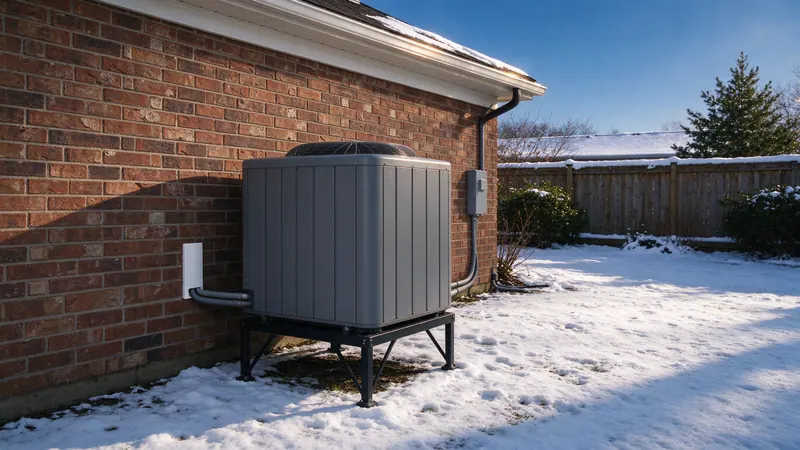
NOAA's 1991 to 2020 normals put annual snowfall at about 49 inches at the old Stapleton station, roughly 9 miles from central Aurora. Placement decides whether the unit breathes and drains through that.
- A stand or wall bracket that lifts the coil above typical drifts
- Out from under the roof drip line, so icicles and sheet ice don't land on the fan
- A clear path for melt water, so defrost runoff doesn't refreeze into a sheet under the unit
- Room on every side for air, and away from the corner where drifts pile up
- Distance from bedroom windows, yours and the neighbors'
- Stand or wall bracket lifts the coil above typical drifts
- Typical drift line
- Out from under the roof drip line
- Clear path for melt water
- Room on every side for air
What it feels like at the register
Many people's first winter question is why the air feels cooler than the old furnace's. It is supposed to.
Gas furnace
Short, hot blasts of air, often well over 120°F at the register, then long pauses while the house cools down again.
Heat pump
Longer, steadier runs of air that leaves the register noticeably cooler than furnace air, often in the 90s. The rooms hold a more even temperature, provided the ducts carry the airflow.
Why variable speed matters most in winter
Most cold-climate models use an inverter-driven, variable-speed compressor. That design is a big part of how they hold output in the cold.
On a cold night
The compressor speeds up past its nominal rating to keep delivering heat, which is how a unit holds 70% or more of its capacity at 5°F.
On a mild day
It slows right down and runs long, quiet cycles instead of starting and stopping. A single-stage unit has one speed, so it short-cycles in spring and runs out of output sooner in a cold snap.
High elevation and dry air
Thin air carries less heat per cubic foot than air at sea level, and Colorado's dry winter air means the outdoor coil frosts less often than in a damp climate. Neither is a reason to avoid a heat pump. Both are reasons we measure airflow at start-up instead of trusting the factory setting.
Planning for your coldest nights
The right question is not whether a heat pump works in the cold but how much of your house it carries at 5°F and what covers the rest. Our backup heat guide compares electric strips and dual fuel, and the planning guide walks the whole decision. Call Sundog at (719) 417-2475 or book a visit and we will show you the cold-night numbers for your house.
Get an EstimateQuestions people ask
Does a heat pump stop working below a certain temperature?
Not at one fixed temperature. Each model has its own published operating range and output curve, and the house's heat loss sets where backup takes over. We check both before recommending equipment.
How often does a heat pump defrost?
It depends on humidity and coil temperature, not a fixed clock. In dry cold it may rarely defrost; in damp weather near freezing it can cycle more often, each time for a few minutes.
Does a cold-climate heat pump in Aurora still need backup heat?
Most do, for the coldest hours and defrost. Whether a house can go without depends on its heat loss and the model's 5°F output, and we show you those numbers before you decide.