Last Updated: November 2026
The short answer
In many Aurora-area homes it is not either-or. A heat pump takes the AC's place and carries the mild and moderate part of winter. A gas furnace can stay as backup for the coldest hours, or a cold-climate heat pump with electric backup can replace it. Your furnace's condition, your rates and your heat loss decide which.
How each one makes heat
The two machines work in different ways, so their efficiency numbers mean different things.
Gas furnace: burns fuel
A furnace's AFUE rating is the share of the gas's energy that ends up as heat in the house. A 96% furnace delivers 96,000 BTU of heat for every 100,000 BTU therm it burns, on the coldest night and the mildest one alike. It heats only; you still need an AC for summer.
Heat pump: moves heat
A heat pump pulls heat from outdoor air and moves it inside, then reverses to cool in summer. Its efficiency is the coefficient of performance, or COP: units of heat delivered per unit of electricity. COP falls as the air gets colder. ENERGY STAR's cold-climate designation requires a COP of at least 1.75 at 5°F, and mild-weather COP runs well above that.
Which one costs less to run
Running cost comes down to price per unit of heat delivered, and in Colorado that is close. Gas is usually cheap per therm, so the heat pump has to work at a fairly high COP to beat it. The table shows the COP a heat pump needs to match a 95% furnace at different all-in rates. Read your own rates from your Xcel bill, then find your row; our operating cost guide shows how.
| All-in electric rate | Gas at $0.80 per therm | Gas at $1.00 per therm | Gas at $1.20 per therm |
|---|---|---|---|
| $0.10 per kWh | COP 3.5 | COP 2.8 | COP 2.3 |
| $0.13 per kWh | COP 4.5 | COP 3.6 | COP 3.0 |
| $0.16 per kWh | COP 5.6 | COP 4.5 | COP 3.7 |
The math behind it is short. One therm holds as much heat as 29.3 kWh. Multiply your electric rate by 29.3 and by the furnace's AFUE, then divide by your gas rate: that is the COP the heat pump needs to tie.
Above the break-even COP the heat pump is cheaper per unit of heat; below it, gas is. In most houses the heat pump clears the mark in mild weather and falls under it on the coldest nights, which is the logic behind dual fuel.
Want your own number? We start from your house and your bills.
Get an EstimateHow each one feels on a cold night
Comfort differs as much as cost, and it is where most people's doubts sit.
Supply air
A furnace blows air well above body temperature in short bursts. A heat pump delivers cooler air for longer, so rooms stay more even but the register feels less hot. Ducts need to carry the full airflow; our ductwork guide covers what that takes.
Cold snaps
Every heat pump puts out less heat as the outdoor air cools. We choose equipment by its published output at 5°F, so you know how much of the house it carries before backup starts. More on that in cold-weather performance.
Defrost
In damp cold the outdoor coil frosts and the unit reverses for a few minutes to clear it. Backup heat covers those minutes, so you do not feel a draft.
Backup
With a furnace, gas covers the coldest hours. Without one, an electric strip in the air handler does, at a COP of 1. The backup heat guide compares both.
Four houses, four answers
The right call depends on what is already in the basement.
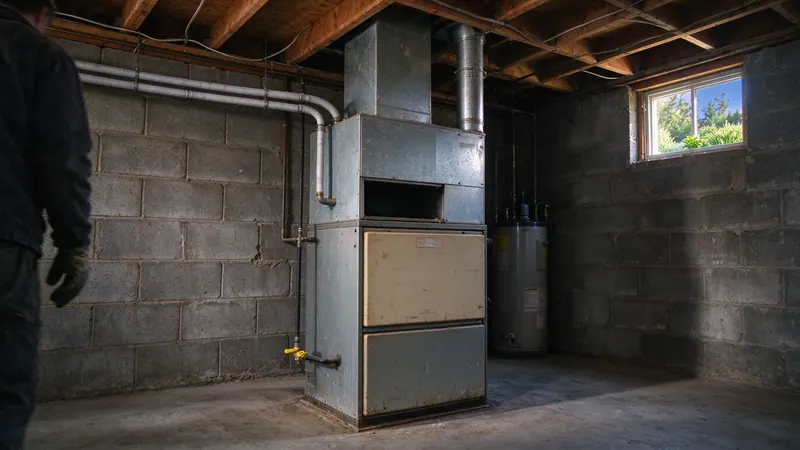
The AC died and the furnace is sound
Keep the furnace and add a heat pump in place of the AC. The furnace becomes backup below a changeover temperature we set from your rates. The coil and blower must match the heat pump.
The furnace and AC are both near the end
Replace both together. Sundog's typical range for dual fuel with a new furnace and cold-climate heat pump is $19,000 to $28,000; an all-electric cold-climate system sits in the $13,000 to $25,000 range when the panel has room.
You heat with an electric furnace or baseboard
A heat pump wins on running cost at any COP above 1, because resistance heat is COP 1. The question becomes capacity and the panel, not gas rates.
Some rooms never get warm
Fix the airflow first, or heat those rooms with a ductless head. Neither fuel solves a crushed return.
What we check before recommending either
On the visit we measure first and recommend second. You see what each check found.
- A room-by-room load calculation, so the system is sized to heat loss and not the old nameplate
- Furnace age, condition, blower type and coil match
- Static pressure and returns, to see whether the ducts carry heat-pump airflow
- The electrical panel, for the outdoor unit circuit and any electric backup
- Your gas and electric rates from recent bills, to set a changeover point
- Rebates that apply to your address, checked before the estimate is final
Talk it through with your numbers
Call (719) 417-2475 with your furnace's age and a recent Xcel bill, or request an estimate. We show the cold-night numbers for both paths in writing before you decide. To see what each path costs, start with our typical ranges.
Get an EstimateQuestions people ask
Is a heat pump cheaper to run than a gas furnace in Colorado?
It depends on your rates and the temperature. Divide your all-in cost per therm by your all-in cost per kWh, and compare it with the heat pump's COP at that temperature using the table above. In mild weather the heat pump usually wins; on the coldest nights gas often does.
Does a heat pump still heat below zero?
A cold-climate model keeps producing heat well below zero, at reduced output. Whether that output covers your house depends on its heat loss, which is why we check the model's published low-temperature capacity against your load calculation.
Do I have to give up gas to get a heat pump?
No. Dual fuel keeps the furnace for the coldest hours. Going all-electric is a separate choice that depends on the panel and on sizing the backup heat.