Last Updated: November 2026
The short answer
If your house has ducts that can carry the airflow, a ducted heat pump usually fits best and costs less per room. If it has no ducts, or one addition or bedroom the ducts never reach, ductless fits better. Many Aurora houses end up with both: a ducted system for the main floors and a ductless head where the ducts fall short.
Start with the ducts you have
Most Aurora houses built with a gas furnace already have a supply trunk and returns. The question is whether they work for a heat pump, which moves more air at a lower supply temperature than a furnace.
Ducts that pass
Static pressure within the blower's range, returns sized for the airflow, no crushed runs and sealed joints. A ducted heat pump drops in where the furnace or air handler sits, and every room gets heat and cooling. See ducted installation.
Ducts that need work
A high static reading, one small return or flex runs crushed in a crawlspace. Often a second return or a replaced run fixes it, priced as its own line. When the fix means opening finished ceilings, ductless can be the cleaner answer. Our ductwork guide covers the tests.
- Air handler or furnace in the basement
- Supply trunk
- Returns
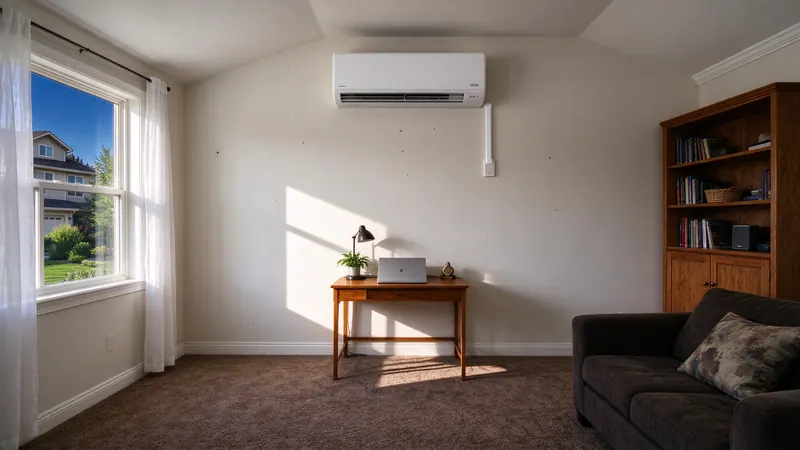
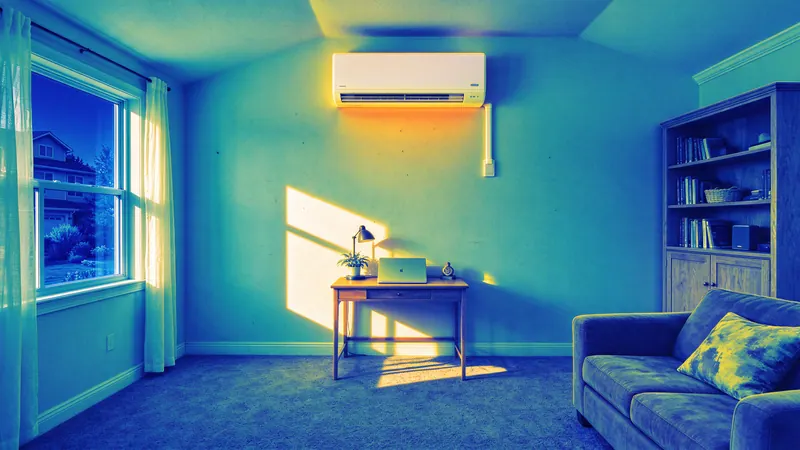
- Ductless head: no ceilings to open
- Line set down the outside wall
- Outdoor unit
Room layout and zone control
Ducted and ductless systems control temperature in different ways, and the layout of the house decides which suits it.
Ducted: one thermostat, whole house
One system conditions the whole duct network. That suits open main floors. Upstairs rooms that run warm in summer or cold in winter can be helped with balancing, an added return or zone dampers.
Ductless: one head, one room
Each head has its own control, so a bedroom can sit cooler than a family room. That suits closed rooms, additions and finished basements, but a head serves only the space it can throw air into. A head in a hallway will not reach the bedrooms off it.
Electrical work for each
Both need a dedicated circuit for the outdoor unit and a disconnect within sight of it. The difference is backup heat.
Ducted, all-electric
An electric strip in the air handler usually needs its own large circuit, which is where panel capacity comes up. With a furnace kept as backup, the strip is not needed.
Ductless
One outdoor unit, one circuit, often 20 to 25 amps for a single zone; the heads are powered from the outdoor unit. Most ductless systems run without a strip. Our panel guide explains the load check.
Want your own number? We start from your house and your bills.
Get an EstimateCold-weather capacity
Ducted and ductless equipment both come in cold-climate models. What matters is published output at low temperature, checked against the load.
Ducted
We choose the outdoor unit by its rated capacity at 5°F against the whole-house heating load, then size the backup to the gap.
Ductless
Each head is sized to its own room's load. A cold-climate head in a well-sized room often carries it without backup, but a room with large windows on the north side may still need one.
Shared rule
ENERGY STAR's cold-climate designation requires COP 1.75 or better at 5°F. It is a useful floor, not a sizing method.
Defrost
Both defrost the outdoor coil in damp cold. A ducted system covers it with backup heat; a ductless head pauses briefly.
What each costs
Sundog's typical ranges show why ducted usually costs less per room when the ducts are sound, and why one or two ductless heads cost less than a whole new system. Exact prices come from the visit and the written estimate; the cost page lists every range.
| System | Sundog's typical range | Covers |
|---|---|---|
| Cold-climate ducted heat pump | $13,000 to $25,000 | The whole house through existing ducts |
| Ductless, one zone | $4,500 to $9,500 | One room or open area |
| Ductless, two to four heads | $9,000 to $18,000 | Several rooms, often one floor |
| Ductless, five to eight heads | $18,000 to $35,000 and up | Most or all of a house without ducts |
Living with each one
The day-to-day differences are small but worth knowing before you choose.
Ducted
Nothing changes inside except the thermostat: air comes from the same registers. One filter at the return gets checked monthly. The outdoor unit replaces the old AC, so the yard looks much the same. Maintenance follows our maintenance checklist.
Ductless
A head on the wall or ceiling of each zone, with its own controller. Each head has washable filters, and its coil and blower wheel need cleaning on a maintenance visit. The indoor fan is quiet, and the room holds a steadier temperature than one served at the far end of a duct run.
When the answer is both
A mixed system is common and sensible. We plan it when:
- The main floors have good ducts but a bonus room over the garage never keeps up
- A finished basement or addition was never ducted
- One upstairs bedroom runs hot in summer even after the ducts are balanced
- The panel can carry a ductless circuit more easily than a large strip-heat circuit
- You want one room on its own schedule, such as a home office
Get the ducts measured first
Call (719) 417-2475 or request an estimate. The visit includes a room-by-room load calculation, duct and airflow checks and a panel check, so you see which path the house supports before you choose. For ductless planning in more depth, read mini-split zone planning or see ductless installation.
Get an EstimateQuestions people ask
Can one ductless head heat a whole floor?
Rarely. A head conditions the space it can throw air into. Closed bedrooms off a hallway usually need their own heads or a ducted system.
Is ductless more efficient than ducted?
Ductless avoids duct losses, which helps when ducts run through unconditioned space. With sound, sealed ducts inside the house, the gap is small. Equipment rating and sizing matter more.
Can I add ductless later?
Yes. A ductless zone is separate from the ducted system, so it can be added when a room needs it. Panel space is the main thing to plan for.