Last Updated: November 2026
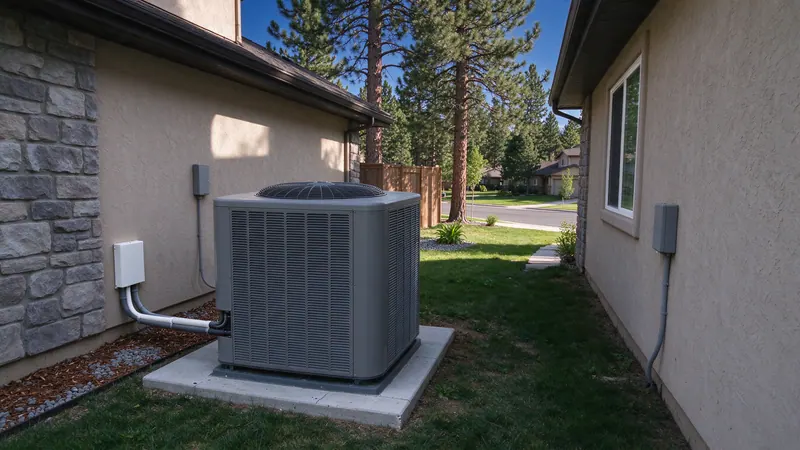
The new heat pump does not automatically belong where the old air conditioner sat, because an AC only ran in summer, while a heat pump runs all winter, frosts over, defrosts, drips meltwater and has to breathe through snow.
On every heat pump installation estimate, we walk the side yards before we price anything. Six things decide the spot.
What the outdoor spot has to handle
Snow
Drifts and plowed or shoveled piles can bury the coil and the base. The unit needs to sit above the snow you actually get, not the snow you hope for.
Roof drip
Water and slush off an eave land on the top and fins, then refreeze into a cap of ice the defrost cycle cannot clear.
Meltwater
Every defrost cycle sheds water from the base. It needs somewhere to go that is not a walkway, a driveway or the foundation.
Wind
Strong wind drives fine snow into the coil and can cause extra defrost cycles. A sheltered side often works better than an open one.
Sound
A modern variable-speed unit is quiet most of the time, but defrost and high-output hours are louder. Distance from bedroom windows matters.
Line set
Every foot between the outdoor unit and the furnace or air handler adds copper, insulation and sometimes refrigerant. Manufacturers set the limits.
Getting the unit above the snow
Along the Front Range, a spring storm or a few weeks of drifting can pile snow against the coil and freeze meltwater into the base pan, so the coil cannot drain or breathe. We set most outdoor units on a stand or raised pad that lifts the unit clear of typical snow depth for that side of the house, with the base open below so meltwater falls away instead of collecting.
Which side of the house counts too. A north side that stays shaded holds snow for days after the south side has melted. A side yard where you pile snow from the driveway needs more height than one you never shovel. We ask where your snow goes in a storm. For how a cold-climate unit holds its output as the temperature drops, see our cold-climate heat pump installation page and the cold-weather performance guide.
Keeping it out from under the roof edge
- Eave drip line: in January the water lands as slush
- Slush freezes on the top grille and fins, layer by layer
- Unit moved out past the drip line
Water dripping from an eave causes more winter trouble on outdoor units than almost anything else about the spot. In January it lands as slush, freezes on the top grille and fins, and builds up layer by layer. Cold-climate guidance hosted by the U.S. Department of Energy recommends avoiding the eave's drip line or deck slats and favors the gable end of the house, where no roof edge sheds water.
Where the gable end is not practical, the choices are to move the unit out past the drip line, add a gutter or diverter above it, or fit a snow and drip shield made for the unit. We price whichever applies as its own line on the estimate.
Want your own number? We start from your house and your bills.
Get an EstimateWhere the defrost water goes
Defrost turns frost into water several times on a cold, damp day, and that water leaves through the base of the unit. On a stand, it falls to gravel or soil below. On a pad next to a sidewalk or a sloped driveway, it runs across the concrete and refreezes into a sheet of ice by evening. We check the grade around the spot, keep the unit away from walkways and doors, and plan a gravel bed. Our post on heat pump frost and defrost explains what the cycle looks like from your yard.
Sound toward your bedrooms and the neighbor's
Variable-speed outdoor units run quietly most of the time, and each model's published sound rating is on its specification sheet. Placement still decides how much of that sound reaches a window. When we choose a spot, we:
- Keep the unit away from bedroom windows, yours and the house next door
- Avoid tight inside corners and narrow gaps between houses, which reflect and concentrate sound
- Set the unit on a stand or pad that does not pass vibration into the wall or deck
- Check whether a quiet or night mode on the selected model suits the location
- Confirm any local noise or HOA placement rules for your address before the estimate is final
Why line-set length changes the plan
The line set is the pair of insulated copper lines that carry refrigerant between the outdoor unit and the coil or air handler inside. Each manufacturer publishes a maximum length, a maximum height difference between the units, and the point at which extra refrigerant has to be added. A spot across the yard that looks ideal can run past those limits, or add cost and lose a little capacity on a long run.
So we measure the route before we settle on the spot: through the rim joist, along the foundation, around a window well. The shortest route that also clears snow and drip usually wins. If your panel is on the far side of the house, the electrical run matters too; our guide to the electrical panel for a heat pump covers that part.
Clearances come from the manufacturer's manual
Every outdoor unit has required clearances: from the wall behind it, above it for discharge air, on the service side, and from things like the gas meter, a dryer vent and a furnace's exhaust and intake pipes. Those distances differ by model, so we take them from the installation manual of the equipment on your estimate rather than from a rule of thumb. The same manual sets the stand and mounting requirements. Aurora reviews the mechanical work through its permit, which we pull with the job; our guide to the heat pump installation process walks through the inspection.
Planning the spot with us
The outdoor spot is part of every estimate visit, along with the load calculation, the ducts and the panel. You will see where we plan to put the unit, why, and what the stand, shield or line-set length adds, each on its own line. If you are weighing a ducted system against ductless heads, placement works the same way for both. To plan yours, contact us or call (719) 417-2475.
Get an EstimateQuestions people ask
Can the heat pump go where my old AC sat?
Often, if that spot is clear of the roof drip line, high enough above snow, short enough on the line set and not right under a bedroom window. If it fails one of those, a few feet of change usually fixes it.
Should I build a cover over the outdoor unit for winter?
Not a tarp or a wrap; the unit needs air moving through the coil all winter. A shield made for the model, or a roof overhang high enough to leave the top open, is a different matter and is planned with the install.
How far from the house does the unit need to be?
The required distance from the wall, and from vents and meters, depends on the model. We take it from the manufacturer's installation manual for the equipment on your estimate.