Last Updated: November 2026
Sundog installs ductless mini-splits and ducted heat pumps in Englewood. Much of the city went up in the postwar building boom, and over the decades some of those houses have gained a finished attic, a basement bedroom or a rear addition the original ducts never reached. A ductless head heats and cools that one space without opening walls on two floors.
Each head is sized from its own room's load calculation, and every visit includes duct and airflow checks and a panel check for the rest of the house. Sundog's typical range for one ductless zone is $4,500 to $9,500, and two to four heads run $9,000 to $18,000. Your price for the rooms you name comes from the site visit and the written estimate.
Rooms that send Englewood owners our way
Each of these is a room problem first. Only one of them is a whole-house problem.
A basement bedroom that stays cold
Basement rooms often get one supply and no return. A small head sized to the room, with lines through the joist bays, carries it without rebalancing the whole house.
A rear addition on baseboard heat
Electric baseboard heats but does not cool. A ductless head does both, and it calls on resistance heat far less than baseboards do.
The ducted system works fine on the main floor
Then keep it. We add zones only where the ducts do not reach, and say so when a ducted heat pump for the whole house makes more sense; our ducted vs ductless guide compares them.
The panel is 100 amps
A single head typically needs one 240-volt circuit. We run a load check on the panel before quoting, as our panel guide explains.
- Main floor: the ducted system works here, so we keep it
- Basement furnace feeding the main floor
- Basement bedroom: a small head sized to the room
- Rear addition on baseboard: a ductless head heats and cools
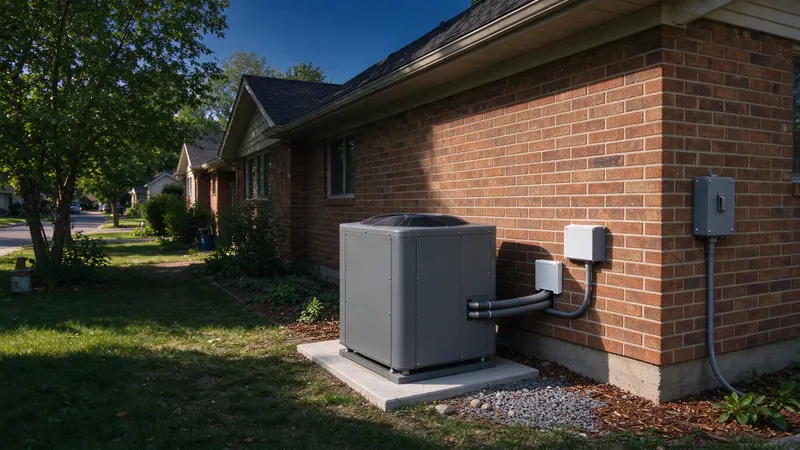
- Outdoor unit for the heads
Heat pump and ductless services in Englewood
Sundog offers these services for Englewood homes:
- Ductless mini-split installation, one zone or several on one outdoor unit
- Ducted heat pump installation where the existing ducts carry the airflow
- Dual-fuel systems that keep a working gas furnace
- Furnace to heat pump conversion for owners going all-electric
- Repair and maintenance for ducted and ductless systems
How an Englewood job usually runs
Room by room
A load calculation for each room that needs a head, plus a look at the main system's ducts and airflow. A head sized to its own room avoids the short cycling that comes from one oversized unit stretched across several rooms.
Head and line plan
We mark the head location, the wall penetration, the line route and where condensate drains on a sketch before the estimate.
Panel check
Existing load added up and a circuit planned for each outdoor unit. In a house with an original or older panel we also look at its condition and labeling, because a full panel with no spare spaces changes the electrical line on the estimate even when the amperage is there.
Permits
City of Englewood mechanical and electrical permits, confirmed for the scope with the Building Division before the estimate is final, so the permit line on it reflects your rooms and circuits.
Install and start-up
A single head is usually a one-day job. Line-hide painted to the trim, readings recorded and left with you.
Englewood houses and where heat pumps fit
Englewood is one of the oldest cities we serve, and its age shapes where heat pumps fit.
Postwar houses, later additions
Census estimates put Englewood's median year built at 1964, give or take three years, the oldest among the places on our service map. A building boom began after 1948 and most of the city was built up by 1960. Houses of that era were laid out for a basement furnace feeding the main floor. Rooms added since are where ducts tend to fall short, and where a ductless zone usually beats extending the trunk.
Gas furnaces, some electric heat
About 60.5% of occupied homes heat with utility gas and 34.5% with electricity. A gas home with a working furnace can keep it and add ductless zones, or move to dual fuel when the AC fails. An electric-heat home with baseboards is a natural fit for multi-zone ductless, sized room by room as our zone planning guide explains.
City permits on Englewood Parkway
Englewood, incorporated in 1903 in western Arapahoe County, runs its own Building Division at 1000 Englewood Parkway. Its guidance lists furnace and air-conditioning replacement and added heating systems among the work that needs a permit. Broadway and Hampden Avenue divide the city into quadrants, and the northwest section holds housing from the 1910s, where the panel and wiring get an extra look before any new circuit.
Extend the ducts or add a ductless zone
Extending ducts makes sense when the furnace has spare capacity and the route is open. In older Englewood houses, it often is not.
| Extend the ducts | Add a ductless zone | |
|---|---|---|
| Walls opened | Often on two floors | One small penetration per head |
| Effect on the main system | Adds load to a furnace that may have none to spare | None; the zone runs on its own |
| Control | Shares one thermostat | Its own control in the room |
| Sundog's typical range | Priced per job after the visit | $4,500 to $9,500 for one zone |
Heating and cooling an Englewood attic bedroom
- Project price
- $6,200
- On site
- 1 day
- Where
- Englewood
- The house
- 1960s ranch with converted attic bedroom
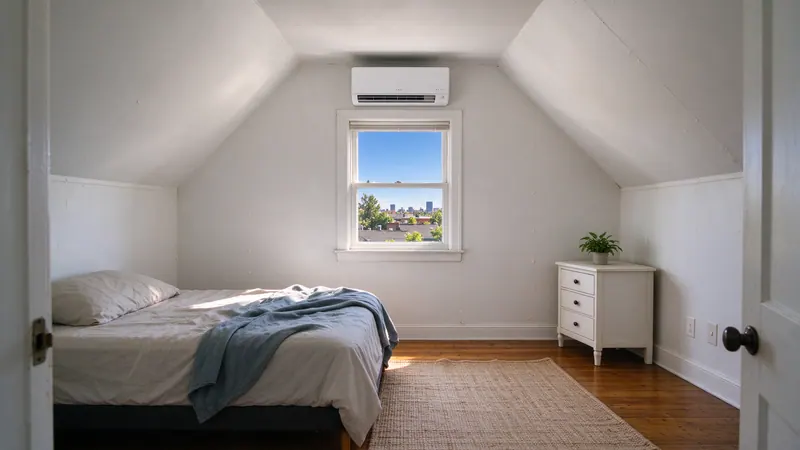
Englewood's housing centers on the 1960s, and some of its small ranches have had the attic finished into a bedroom along the way. This one was about 280 square feet under sloped ceilings with knee walls, and no duct ever reached it. The basement furnace and AC served the main floor, so the room baked in July and needed a portable heater in January.
Running a duct up from the basement meant opening finished walls on two floors, and the furnace had no spare capacity for another room anyway. So we treated the attic as its own zone: one 12,000 BTU cold-climate wall head sized from a load calculation for that room.
The sloped ceiling left one good wall, the gable end, and that also gave the cleanest route out. We cored one 3.5-inch penetration high on the gable, hung the head clear of the slope, and ran about 30 feet of line set and condensate straight down the outside in PVC line-hide, so the condensate falls continuously to grade. The work ran from a ladder with a stand-off at about 14 feet. The outdoor unit went on a ground stand below.
The older 100-amp panel had room for one 20-amp, 240-volt circuit after a load check. We pressure tested, pulled a vacuum, commissioned the head and painted the line-hide to match the trim before the city's inspection.
Cold-climate ductless by number of zones
For rooms that have to stay warm through a cold snap, we choose cold-climate heads with published low-temperature capacity. These are Sundog's typical ranges by zone count; line length, wall type, panel work and head style move a job within them.
| Cold-climate ductless | Sundog's typical range |
|---|---|
| One zone | $4,500 to $6,500 |
| Two zones | $8,500 to $12,500 |
| Three zones | $12,500 to $18,500 |
| Four or five zones | $17,500 to $26,000 |
Where the lines and the water go
- Head placed so the drain falls on its own
- Line set, cable and condensate in a painted line-hide cover
- Condensate falls to grade
- Outdoor unit
A ductless head needs three things besides a wall: a refrigerant line set to the outdoor unit, a power and control cable, and a path for condensate. The condensate is the one that decides placement most often. In cooling, and in some heating conditions, the head produces water that has to fall continuously to a drain or to grade, or be lifted by a small pump.
In a basement room we usually run lines and drain through the joist bays to the rim joist. In an addition, through the attic or straight down an exterior wall in a painted line-hide cover. We choose the head location so the drain falls on its own wherever we can, because a pump is one more part to fail. All of it goes on the sketch at the visit.
Tell us which room
Name the rooms that run hot or cold, what heats them now and the panel rating if you know it. You hear back with a first range for those rooms from our typical rates, and then we set the visit. Call (719) 417-2475 or get an estimate.
Get an EstimateHeat pump questions in Englewood
How much does a ductless mini-split cost in Englewood?
Sundog's typical range for one ductless zone is $4,500 to $9,500, and two to four heads run $9,000 to $18,000. For cold-climate ductless, one zone is $4,500 to $6,500 and two zones $8,500 to $12,500. Line length, wall type and panel work set your price at the site visit.
Can a mini-split heat a room through a Colorado winter?
A cold-climate head chosen by its published low-temperature output can carry a well-sized room through most of the winter. We size each head to its room's load, not to the biggest unit that fits the wall.
Where does the condensate from a ductless head go?
It drains by gravity to grade or to an indoor drain wherever the layout allows, through the line-hide cover or the joist bays. Where it cannot fall on its own, a small condensate pump lifts it.
Does Englewood require a permit for a mini-split?
Englewood's guidance lists added heating systems and furnace and AC replacement among work that needs a permit. A mini-split involves mechanical and electrical work, and we confirm the permits with the city's Building Division for your scope.
Will my 100-amp panel handle a mini-split?
Often, for one or two heads. Each outdoor unit needs its own circuit, and we run a load check on the panel before quoting. If it is close, the estimate shows the options.